6 Features of a Successful Cardiac Diabetic PCD Pharma Franchise [Infographic]

The pharmaceutical industry continues to grow rapidly, with increasing demand for specialised segments such as cardiac and diabetic care. These therapeutic areas require consistent availability of quality medications, making them attractive for business opportunities within the PCD pharma franchise model. Success in this space depends on selecting the right company and operational approach.

A cardiac diabetic PCD pharma franchise focuses on distributing medicines related to heart health and diabetes management. It involves collaboration with a pharmaceutical company that provides products, marketing support, and distribution rights within a specific region.

Understanding the key characteristics of a cardiac diabetic PCD pharma franchise can help entrepreneurs choose the right partnership and build a sustainable business. Below is an infographic outlining six essential features that define a successful pharma franchise.

6 Features of a Successful Cardiac Diabetic PCD Pharma Franchise

How Monopoly Pharma Franchise Rights Protect Your Investment and Profitability

A monopoly pharma franchise gives pharma entrepreneurs exclusive territorial rights, predictable profit margins, and a business model free from internal brand rivalry. This combination creates the foundation for sustainable growth in India's competitive pharma distribution market.

Key Takeaways:

Entering the pharmaceutical distribution market without territory protection is a gamble few entrepreneurs can afford to take. A monopoly pharma franchise removes that uncertainty from the equation. It gives partners the legal right to operate within a defined area, free from competition by fellow franchise holders of the same brand. That single difference shapes everything about how a business performs and grows.

For any franchisee looking to build a stable income, the value of a monopoly pharma franchise becomes clear very quickly. When no other partner from the same company can enter your area, every doctor, chemist, and clinic you convert stays yours. The returns from every relationship you build flow directly back into your own business growth.

When Markets Get Crowded, Margins Disappear

What Exclusive Territory Actually Delivers

What a Clear Territorial Agreement Looks Like

The Real Advantages of Territorial Exclusivity

Why Serious Franchisees Prioritise Territory Above Everything: Every experienced pharma entrepreneur will say the same thing. The deal structure matters less than the geography. Getting the right territory with clear written exclusivity is the foundation of a profitable franchise business. Without it, effort does not translate into income in any predictable or consistent way. With it, even smaller territories become manageable and worth investing in seriously.

Key advantages that territorial exclusivity delivers for a franchise partner:

Where the Right Franchise Deal Changes Everything

The difference between a franchise that stagnates and one that grows steadily often comes down to one document. Territorial exclusivity in writing, with a wide product portfolio and genuine partner support, gives distributors a rare kind of certainty in a market that rarely offers it. Anyone serious about building a pharma business should start here: ask for the territory agreement before anything else.

7 Key Aspects of a Derma PCD Franchise to Evaluate [Infographic]

Skin care remains one of the fastest-growing segments in India's pharmaceutical market. Dermatology products have strong demand across urban and rural areas alike, driven by rising awareness of skin health and a growing preference for branded formulations. For pharma entrepreneurs looking to enter a high-demand therapeutic category, this segment offers consistent prescription volume and potential for repeat business. Choosing the right franchise partner can make the difference between a slow start and rapid territory growth.

A derma PCD franchise gives entrepreneurs access to a ready portfolio of dermatology products across creams, ointments, gels, lotions, soaps, and oral formulations. Partners typically receive exclusive distribution rights, professional promotional support, and WHO-GMP-compliant products that build prescribers' confidence from day one. With packaging tailored for the derma segment and competitive pricing, this model gives partners a strong foundation to capture market share in their assigned territories. Whether targeting dermatologists, general practitioners, or retail pharmacies, the product range covers conditions that drive daily prescriptions. To get a quick snapshot of what a derma franchise opportunity typically entails, the following infographic highlights the key aspects to consider before making a decision.

7 Key Aspects of a Derma PCD Franchise to Evaluate

What Does Monopoly Basis Mean in a PCD Pharma Franchise?

Monopoly basis gives you exclusive rights to sell a company's products in your defined territory, meaning no other distributor from that brand can compete in your zone. Without it, you share your market, your accounts, and the returns on every relationship you build. Getting this right before you sign is what separates a real pharma distribution business from a losing arrangement.

Key Takeaways

If you've been looking at pharma franchise opportunities, you've probably come across the term "monopoly basis" more than once. Most people skim right past it without giving it a second thought. That's a mistake, and often a costly one. Before you sign up with any company, compare product lists, check profit margins, or even think seriously about territory allocation, there is one question that matters more than anything else. It's whether you're getting a genuine PCD pharma franchise on a monopoly basis. That single factor determines whether you're building something real or just competing against five other distributors selling the exact same products in your area.

What Monopoly Basis Actually Means

Here's what PCD pharma franchise monopoly basis actually means.

When a company offers a franchise on a monopoly basis, you get exclusive rights to sell its products in a defined geographic territory. No other franchise partner from that company can operate in your zone. You own that market, at least within that brand's portfolio.

That sounds straightforward. And it is. But most people don't think through what happens when they don't get this.

What You Lose Without Monopoly Rights

Without monopoly rights, you're sharing your territory. Another distributor can approach the same doctors, the same pharmacies, the same hospitals. You do the groundwork, build the relationships, and someone else benefits from it too. That's not a business. That's a shared burden.

This is why monopoly basis matters so much to anyone serious about building a pharma distribution business.

What Monopoly Rights Give You

Your territory is yours alone. When you hold monopoly rights, doctors and chemists in your area can only get those products through you. That creates consistent demand and repeat orders. You're not fighting for shelf space against someone from the same company.

You control your pricing power. Without competition from within the same brand, you set the terms. You decide how to approach accounts and how to grow. That control is what separates a real business from a side arrangement.

Your relationship-building pays off. Building trust with a doctor or pharmacist takes time. When you have monopoly rights, that investment stays with you. When you don't, it can be undercut at any point.

Documents You'll Need Before You Start

A genuine monopoly pharma franchise company will ask for basic documentation before assigning you a territory. You'll need a valid wholesale drug license in your name or your company's name. Without it, no legitimate PCD pharma company can legally supply medicines to you. You'll also need GST registration to handle billing and taxation correctly.

Have these ready before you approach any company. It speeds up the process and signals that you're a serious partner.

Getting It Right From the Start

The pharma franchise market has grown steadily across India. There's a real opportunity here. But the difference between a franchise that pays off and one that doesn't often comes down to whether you held genuine monopoly rights from day one.

Get that part right first. Everything else follows from there.

Featured Image Source: https://images.pexels.com/photos/9742744/pexels-photo-9742744.jpeg

2026 Franchise Trends: Expecting Success from an Ayurvedic PCD Company in India

The landscape of natural wellness is undergoing a massive shift as the year 2026 approaches. Global demand for herbal solutions has positioned every ayurvedic PCD company in India as a pivotal player in the modern healthcare sector. Entrepreneurs are now looking toward ancient wisdom combined with modern delivery systems to satisfy a much more informed and health conscious consumer base.

Choosing to partner with a reputable ayurvedic PCD company in India ensures access to a market that values purity and long term results. As synthetic alternatives face increasing scrutiny, the move toward plant based medicine provides a stable and lucrative path for new franchise owners. Success in this field relies on aligning with brands that prioritise authentic ingredients and ethical manufacturing.

Harnessing Ancient Wisdom Through Modern Standards

Capturing The Shift In Global Wellness Desires

Navigating Competitive Waters With Authority

Securing Your Legacy In Natural Healthcare

The journey toward building a profitable herbal empire requires a partner that understands the delicate balance between tradition and future technology. Avoiding the pitfalls of low grade suppliers ensures that your reputation remains untarnished and your business continues to grow year after year.

Professional guidance and superior product standards turn an aspiring entrepreneur into a respected leader within the local wellness community. Take the final step toward financial independence by securing your territory today and launching a venture that brings genuine health benefits to your entire region.

Featured Image Source: https://media.gettyimages.com/id/2166294499/photo/close-up-of-the-automatic-capsule-package-production-line.jpg?s=612x612&w=0&k=20&c=fynd3puYsPXQhoERPR7uvQzrY_KsomfoiS49_mA131o=
2026 Guide: Evaluating the Best PCD Pharma Company in India

The pharmaceutical landscape in the year 2026 presents a massive opportunity for entrepreneurs looking to capitalise on the rapid expansion of healthcare infrastructure. Identifying the best PCD pharma company in India is the primary step for anyone wanting to build a sustainable and highly profitable business. This sector remains a dominant force in providing accessible medicines across diverse regional markets.

Selecting the best PCD pharma company in India ensures that a partner has access to high quality formulations and reliable supply chains. Success in this competitive field requires a collaborator that stays ahead of medical trends and regulatory shifts. Aspiring distributors thrive when they align with organisations that prioritise patient health and consistent product availability in every city.

Strategic Advantages in a Shifting Medical Market

Maximising Returns Through Proven Operational Strength

Accelerating Growth With Future Proof Strategies

Empowering Your Pharmaceutical Career Path

The decision to enter the medicine distribution sector requires a partner that offers both stability and a vision for the future. Avoiding the traps of low quality suppliers and inconsistent stock is the only way to protect your investment and reputation.

Professional support and high grade products turn a small startup into a leading regional provider of essential healthcare solutions. Take the definitive step toward securing your future by partnering with a leader that values your growth as much as their own success.

Featured Image Source: https://media.gettyimages.com/id/2261372518/photo/close-up-of-red-and-pink-hard-gelatin-capsules-on-stainless-steel-tray-of-automated-medicine.jpg?s=612x612&w=0&k=20&c=FpxknsciQNhbQh9rrIoc7yqp9W_EXgbs3zKfmxcIXW8=

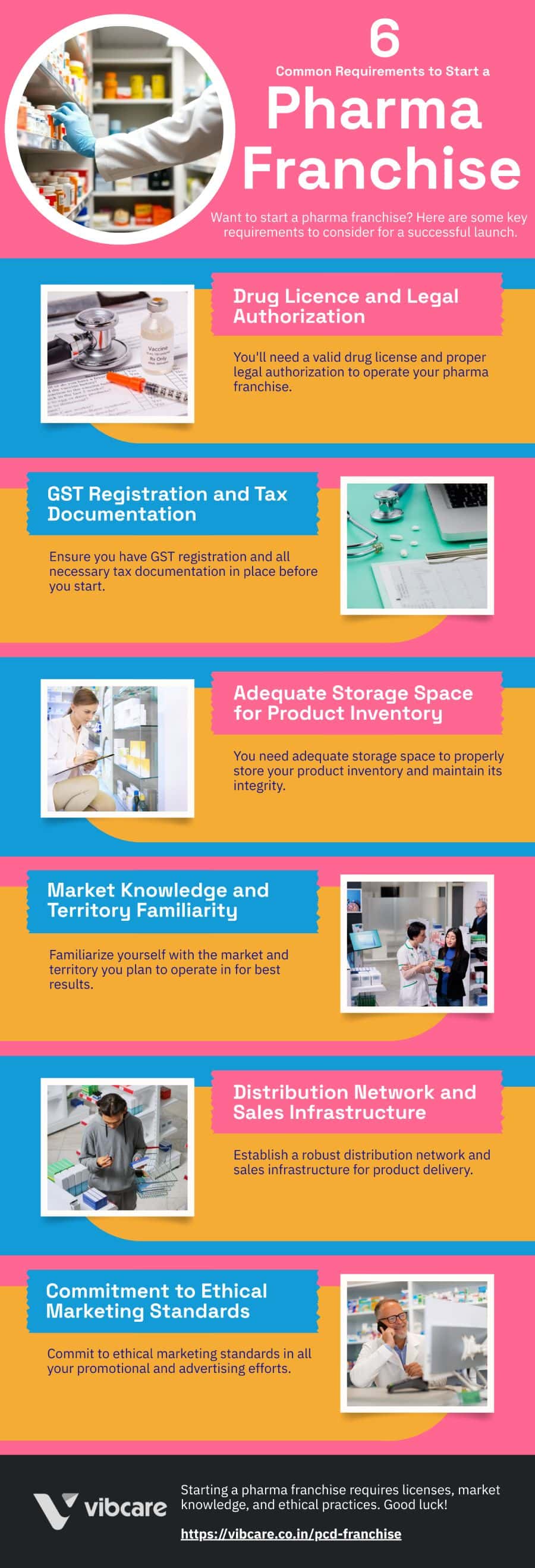
6 Common Requirements to Start a Pharma Franchise [Infographic]

Starting a pharma franchise requires meeting specific business prerequisites to legally market and distribute pharmaceutical products under a PCD pharma franchise model in your territory. Understanding these entry requirements helps entrepreneurs prepare properly before partnering with a pharma franchise company.

The pharma franchise business model is built on territory-based distribution rights, where partners handle marketing and sales within designated areas. Meeting these foundational requirements allows you to establish a legitimate pharma franchise business and begin operations smoothly.

When exploring a pharma franchise, understanding these prerequisites helps you assess your readiness and avoid delays during onboarding.

Here's an infographic outlining 6 common requirements to start a pharma franchise.

6 Common Requirements to Start a Pharma Franchise

Why Quality Standards Define Your Pharma Partnership Succes

The pharmaceutical franchise landscape presents entrepreneurs with countless partnership options, yet only rigorous quality frameworks separate profitable ventures from problematic ones. Selecting the best PCD pharma company requires evaluating systematic quality control processes that protect both business reputation and patient safety. Understanding these quality benchmarks helps franchisees build sustainable distribution networks grounded in product reliability.

A best PCD pharma company maintains comprehensive quality assurance protocols spanning raw material procurement through final product dispatch. These systems ensure consistent therapeutic efficacy, regulatory compliance, and market credibility. Franchise partners benefit directly from supplier quality standards through reduced product returns, enhanced prescriber confidence, and territory reputation protection that drives repeat business growth.

Quality Frameworks That Protect Franchise Investments

Regulatory Certifications That Signal Partnership Reliability

Evaluation Strategies for Franchise Quality Assessment

Prospective franchisees need systematic approaches to verify supplier quality claims before committing to partnerships. The following assessment criteria help identify reliable suppliers:

Quality Systems That Drive Territory Success

Building Sustainable Partnerships Through Quality Assurance

Franchise success depends fundamentally on supplier quality systems that protect market reputation and ensure consistent product performance. Evaluating GMP compliance, regulatory certifications, and quality documentation during partner selection prevents costly associations with substandard suppliers. Smart franchisees prioritise quality frameworks over initial pricing advantages, recognising that consistent product reliability drives long-term profitability.

Partner with pharmaceutical suppliers demonstrating verifiable quality credentials through transparent documentation and regulatory compliance. Request comprehensive quality assurance information during franchise evaluation, examining batch records that reveal true production standards. Build your distribution business on quality foundations that sustain prescriber confidence and territory growth.

Featured Image Source: https://media.gettyimages.com/id/1504176609/photo/green-pill-at-conveyor-belt.jpg?s=612x612&w=0&k=20&c=Ri-72byr0KszsvdrlLJT_w8ibaLIAovIVKRSGbpAR90=

Long-Term Growth with PCD Pharma in Chandigarh: Tips for Scaling Your Franchise Business

Starting a PCD Pharma in Chandigarh is one thing; scaling it into a profitable, sustainable business is another challenge altogether. Many distributors face stagnation after the initial momentum fades, struggling to expand beyond familiar territories or product segments. The real test begins when early wins plateau and competition intensifies.

Building long-term success with PCD Pharma in Chandigarh requires deliberate strategies that go beyond basic operations. Franchise partners who invest in continuous market research, expand their therapeutic offerings, and strengthen local networks consistently outperform those who remain static. Growth demands intentional action, especially when regional competitors are equally hungry for market share.

Strategic Product Expansion Beyond Early Wins

Promotional Systems That Drive Sustained Growth

Training Systems That Prevent Stagnation

Building Local Intelligence Networks

Partner Strength Determines Scaling Potential

Building Momentum That Lasts

Scaling a pharma franchise in Chandigarh demands strategic expansion across therapeutic divisions, systematic promotional reinforcement, and continuous skill development. Choose franchise partnerships that provide the product depth, support infrastructure, and territorial protection necessary for sustained growth. Your trajectory depends entirely on the systems you build today.

Featured Image Source: https://media.gettyimages.com/id/1285238070/photo/female-worker-selecting-spare-parts-in-a-factory-store-area.jpg?s=612x612&w=0&k=20&c=i3goFhMFnKAdR0zRHdDyAZV-QjAGBfhRJhuD_5QkQzY=

Multinational Pharma Franchise Company: Complete 2026 Guide

Last updated: 5 February 2026

Multinational Pharma Franchise Company in India (2026 Guide)

Looking for a multinational pharma franchise company that combines global quality standards with Indian accessibility? This comprehensive guide explains what "multinational-grade" really means in the pharma franchise space, how to evaluate partners, compliance requirements, and how Vibcare Pharma delivers WHO-GMP quality with local partnership flexibility.

🎯 Quick Navigation:

  • What "multinational" means: Global quality standards + India accessibility
  • Key compliance requirements: Licensing, GMP, GDP, ethical marketing
  • Selection framework: 12-point due diligence checklist
  • Vibcare advantage: 1500+ products, 11 divisions, 40+ years legacy

What is a multinational pharma franchise company?

Understanding the "multinational" terminology

The term "multinational pharma franchise company" can mean two things in the Indian market:

  1. Literal multinational corporations: Global pharmaceutical giants like Sanofi, GSK, Novartis, or Abbott operating in India
  2. Multinational-grade Indian partners: Indian pharma companies operating with global quality standards (WHO-GMP), international compliance, and export capabilities

Critical distinction: Most entrepreneurs searching for "multinational pharma franchise" want the quality assurance and reliability of global standards, but need the accessibility and partnership flexibility of an Indian PCD (Propaganda Cum Distribution) model.

In practice, a multinational-grade pharma franchise partnership should offer:

  • ✓ WHO-GMP certified manufacturing standards
  • ✓ Good Distribution Practices (GDP) compliance
  • ✓ Export quality products for domestic market
  • ✓ Ethical promotion aligned with UCPMP 2024 guidelines
  • ✓ Operational scale and supply chain reliability
  • ✓ Partnership accessibility (unlike global MNCs requiring ₹50L+ investments)

💡 Key Insight: The best multinational pharma franchise partners in India bridge the gap between "global quality you can trust" and "local partnership you can access."

Why businesses prefer "multinational-grade" franchise partners

Quality Consistency

WHO-GMP systems ensure batch-to-batch consistency and minimize defect risks that can damage your reputation with prescribing doctors.

Distribution Integrity

Proper storage and distribution practices protect product efficacy from manufacturing to patient delivery.

Supply Reliability

Large-scale operations with 40+ years of experience ensure uninterrupted supply during peak demand periods.

Regulatory Compliance

Partners operating with multinational standards maintain documentation and quality controls that survive regulatory audits.

Professional Credibility

Association with WHO-GMP certified companies builds immediate trust with healthcare professionals.

Market Responsiveness

Broad product portfolios (1500+ SKUs) allow you to capture complete prescription share without multiple partners.

Franchise partner comparison matrix
Factor Global MNC (Sanofi/GSK) Local Startup Multinational-Grade Indian Partner (Vibcare Model)
Quality Standards US-FDA, EU-GMP Domestic GMP (variable) WHO-GMP, ISO 9001:2015
Accessibility Very High barrier (₹50L+) Low barrier Accessible (₹25K-₹50K start)
Monopoly Rights Rarely offered Often promised, inconsistently enforced Documented territory exclusivity
Product Range Focused/Limited per division 50-200 products (narrow) 1500+ products, 11+ divisions
Supply Reliability Very High Variable (stock-out risk) High (same-day dispatch systems)
Partner Support Minimal (corporate structure) Ad-hoc Dedicated account management + tools

Tangible benefits you should demand in a franchise agreement

When evaluating any multinational pharma franchise opportunity, these are non-negotiable operational capabilities:

Essential partnership features

  • Monopoly/territory exclusivity: Written protection preventing company from appointing competing distributors in your area
  • Marketing enablement: Visual aids, MR bags, reminder materials, product literature, digital support tools
  • Commercial transparency: Clear PTR/PTS formulas, margin calculators, no hidden costs
  • Dispatch SLAs: Same-day or next-day order processing with real-time tracking
  • Documentation pack: Product catalogue, stability data, tender dossiers, quality certificates
  • Training support: Product knowledge, ethical promotion practices, market development guidance
  • Account management: Dedicated relationship manager, responsive support channels
  • Returns policy: Clear expiry/damage returns handling mechanism

Compliance and risk controls

This is where multinational-grade partners differentiate from opportunistic operators. Genuine quality-focused companies implement systematic controls across manufacturing, distribution, and promotion.

Manufacturing quality systems (WHO-GMP fundamentals)

WHO defines Good Manufacturing Practice as a system ensuring products are consistently produced and controlled to quality standards appropriate to their intended use, minimizing risks that cannot be detected through final testing alone.

What this means practically: Batch documentation, validated processes, contamination controls, stability testing, complaint/recall systems.

Distribution integrity (GDP compliance)

WHO Good Storage and Distribution Practices ensure product quality is maintained throughout the supply chain—from manufacturer to patient.

Key elements: Temperature-controlled storage, vehicle qualification, transit packaging, first-in-first-out inventory rotation, cold chain for sensitive products.

Licensing basics for franchise partners

📋 Required licences (India):

  • Form 20-B: Wholesale distribution of drugs (excluding Schedules C, C1, X)
  • Form 21-B: Wholesale distribution of Schedule C and C1 drugs
  • GST registration: For inter-state transactions and input tax credits
  • FSSAI registration: If distributing nutraceuticals/food supplements

Note: Requirements vary by state. Consult your state drug controller for current application procedures.

Ethical promotion controls (UCPMP 2024)

India's Uniform Code for Pharmaceutical Marketing Practices (UCPMP 2024) establishes ethical interaction standards between pharma companies and healthcare practitioners.

Core principles: No inappropriate gifts/inducements, disciplined sampling with caps and records, substantiated product claims, auditable promotional activities.

⚠️ Compliance disclaimer: This guide is educational. Always confirm current regulatory requirements with your state drug controller, tax authorities, and qualified legal/compliance counsel.

How to select the right multinational pharma franchise company

Most pharma franchise marketing pages look identical: "WHO-GMP certified + monopoly rights + marketing support + low investment." Your evaluation must go deeper.

12-point due diligence checklist

  • 1. Manufacturing evidence: Request GMP certificates, audit documentation, facility inspection reports
  • 2. Quality systems: Ask about complaint handling, recall procedures, adverse event reporting
  • 3. Distribution controls: Verify storage practices, vehicle fleet, dispatch SLAs
  • 4. Product documentation: Confirm availability of catalogue, formulation lists, stability data
  • 5. Regulatory compliance: Check DCGI approvals, licence status, price control compliance
  • 6. Territory governance: Get written monopoly agreement with clear geographic boundaries
  • 7. Commercial terms: Understand PTR/PTS, payment cycles, credit terms, returns policy
  • 8. Marketing support: Review actual samples of visual aids, reminder materials, promotional inputs
  • 9. Training program: Confirm product training, market development guidance, ongoing support
  • 10. Technology tools: Evaluate ordering systems, calculators, tracking capabilities
  • 11. Reference checks: Speak with existing franchise partners about experience
  • 12. Exit terms: Understand termination conditions, notice periods, inventory buyback

🚩 Red flags to avoid:

  • Exaggerated "multinational" claims with zero evidence or only a foreign address
  • Vague quality statements without certificates or documentation
  • No clarity on territory protection or exclusivity terms
  • No documented complaint/recall procedures
  • Reluctance to provide reference contacts from existing partners
  • Pressure tactics or "limited time offers" for franchise onboarding

Why Vibcare Pharma is positioned as a strong multinational-grade partner

Vibcare's positioning is not about claiming to be a "multinational corporation." It's about delivering multinational-grade operational capabilities with Indian partnership accessibility.

Vibcare's multinational-grade capabilities

📦 Scale & Portfolio

1,500+ products across 11+ specialized therapeutic divisions

🏭 Quality Infrastructure

WHO-GMP and ISO 9001:2015 certified manufacturing facilities

⏱️ Experience & Stability

40+ years of operational history and market presence

👥 Partner Network

5,000+ customers and 1,500+ successful franchise partners served

🚚 Logistics Excellence

Same-day dispatch capability with multi-channel status updates (email/SMS/WhatsApp)

📱 Digital Tools

Mobile app for ordering, tracking, PTR/PTS calculations, inventory management

🗺️ Territory Protection

Documented monopoly rights with clear geographic exclusivity

🎓 Partner Enablement

Visual aids, MR bags, reminder cards, training, dedicated account management

Therapeutic division coverage

Vibcare operates 11+ specialized divisions, allowing franchise partners to scale across therapeutic areas without changing suppliers:

  • CURE Division: Cardiac & Diabetic (chronic care, high CLV segment)
  • PRIMA Division: General Medicine (high-volume acute therapies)
  • MIND Division: Neuro-Psychiatry (high-margin specialty segment)
  • GRACE Division: Dermatology
  • OPTHO Division: Ophthalmology
  • AUSPIN & Additional Divisions: Pediatrics, Nutraceuticals, and more

Ready to partner with a multinational-grade pharma franchise company?

Evaluate Vibcare's WHO-GMP quality, 1500+ product portfolio, and proven 40-year track record. Request a consultation to discuss territory availability and partnership terms.

Request Franchise Consultation →

Frequently Asked Questions

What does "multinational pharma franchise company" mean in the Indian market?

It typically refers to either global pharmaceutical corporations operating in India, or Indian pharma companies delivering multinational-grade quality standards (WHO-GMP, GDP compliance, export capabilities) through accessible franchise partnership models. Most entrepreneurs seek the latter: global quality with local accessibility.

Do I need a wholesale drug licence to start a pharma franchise?

Yes. In India, you need Form 20-B for wholesale distribution of most drugs, and Form 21-B for Schedule C and C1 drugs. Requirements vary by state, so consult your state drug controller for current application procedures and premises requirements.

What investment is required for a multinational pharma franchise?

Investment varies by company and territory. Global MNCs typically require ₹50 lakhs or more. Indian multinational-grade partners like Vibcare offer entry points starting from ₹25,000-₹45,000 depending on division and territory scope.

How do I verify if a company's "WHO-GMP" claim is genuine?

Request copies of actual GMP certificates, audit reports, and manufacturing facility details. Verify the certificate issuing body and date. Genuine WHO-GMP partners will provide documentation transparently and can arrange facility visits.

What are monopoly rights and why do they matter?

Monopoly rights (also called exclusive territory rights) mean the company will not appoint another distributor for the same products in your designated area. This protects your marketing investment and prevents internal competition. Get this in writing with clear geographic boundaries.

What is PTR and PTS in pharma franchise business?

PTR (Price to Retailer) is the rate at which you sell products to retail chemists. PTS (Price to Stockist) is the rate you pay to the franchise company. The difference between MRP, PTR, and PTS determines your profit margins. Vibcare provides a calculator tool to help partners understand and calculate these margins accurately.

How does ethical promotion (UCPMP 2024) affect pharma marketing?

India's Uniform Code for Pharmaceutical Marketing Practices establishes rules for interactions with healthcare professionals, including limits on gifts, requirements for substantiated product claims, and disciplined sampling practices. Compliant partners provide guidance and tools to help franchisees operate within these ethical boundaries.

What support should a good pharma franchise company provide?

Essential support includes: marketing materials (visual aids, MR bags, reminders), product training, dedicated account management, transparent commercial terms, same-day dispatch capabilities, ordering/tracking tools, and documented monopoly protection.

Why choose Vibcare over other multinational pharma franchise companies?

Vibcare combines multinational-grade quality (WHO-GMP, ISO 9001:2015) with 40+ years of stability, 1500+ product portfolio depth, same-day dispatch systems, digital tools (mobile app, calculators), and accessible partnership terms (₹25K-₹45K entry). This delivers "global quality, local partnership" positioning that bridges the gap between inaccessible MNCs and unreliable startups.

Sources and references

  • World Health Organization (WHO): Good Manufacturing Practices guidelines
  • WHO Technical Report Series: Good Storage and Distribution Practices (TRS 1025, Annex 7)
  • Department of Pharmaceuticals, Government of India: UCPMP 2024 framework
  • Central Drugs Standard Control Organization (CDSCO): Drug licensing and GDP guidance
  • State drug control authorities: Wholesale licence requirements (Forms 20-B, 21-B)
  • Vibcare Pharma official website: Franchise programme and operational documentation