


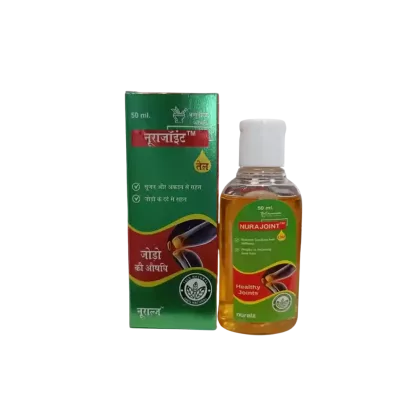
NURAJOINT OILMAHANARYAN OIL 30% IP + ERAND BEEJ OIL 8% IP + GANDHA BIROJA OIL 20% IP + NILGIR...

Send Enquiry

NURALZ
Oil
Packaging and packing Type
| 50ml
MRP :
₹119
PTR :
₹90.67
PTS :
₹81.6
Ayurvedic Read More
Composition
MAHANARYAN OIL 30% IP + ERAND BEEJ OIL 8% IP + GANDHA BIROJA OIL 20% IP + NILGIRI OIL 8% IP + KAPOOR 5% IP + PUDINA OIL 6% IP + LEMON GRASS OIL 2% IP + TILL OIL 20% IP + APARJITA 1% IP
Send Enquiry
India’s Trusted Pharma Brand

100%
Genuine Products

Secure
Payments

24 x 7
Customer Support
About the product
By Vibcare Pharma · Updated 9 October 2026 · Based on product labels and standard drug references
Description

Nurajoint Oil is an Ayurvedic topical oil for external massage. Each 50ml pack contains Mahanaryan Oil 30%, Erand Beej Oil 8%, Gandha Biroja Oil 20%, Nilgiri Oil 8%, Kapoor 5%, Pudina Oil 6%, Lemon Grass Oil 2%, Till Oil 20% and Aparjita 1%. It comes under the class of Ayurvedic joint and muscle massage oils and is packed as 50ml. Nurajoint Oil is from Vibcare Pharma's Nuralz division.
How it works
Till Oil serves as the traditional base that carries the other ingredients during massage. Mahanaryan Oil is a classical Ayurvedic oil used for joints and muscles, while Erand Beej Oil is included in oils for this traditional massage use. Gandha Biroja Oil and Nilgiri Oil give the oil its aromatic character. Kapoor, Pudina Oil and Lemon Grass Oil add cooling and warming sensations on the skin, and Aparjita is included as a supporting herb.
Used for
Nurajoint Oil is traditionally used in Ayurveda for massage of joints and muscles and as a warming, aromatic massage oil for the body. If severe skin irritation, swelling or a rash appears, stop use and see a doctor.
Use under the guidance of an Ayurvedic practitioner.
Side Effects
Common
- Mild warmth or tingling on the skin
- Mild redness at the site of application
- Skin dryness or irritation in some people
- Allergic skin reaction in those sensitive to any aromatic oil
Get medical help at once if you notice
- Severe skin irritation, swelling or rash (stop use and see a doctor)
Uses
- Traditionally used in Ayurveda for massage of joints and muscles
- Traditionally used in Ayurveda as a warming and aromatic massage oil
- Traditionally used in Ayurveda as a topical oil for the daily massage routine
- Traditionally used in Ayurveda as a massage oil for the body
Precautions
Do not use
- Must not be used on broken skin, open wounds or on the eyes
- Must not be taken by mouth
- Must not be used by people with a known allergy to any ingredient
Ask a doctor first
- Check with a doctor first if the skin is very sensitive
- Check with a doctor first during pregnancy or breastfeeding
- Check with a doctor first for children before topical use
Nurajoint Oil: frequently asked questions
What is Nurajoint Oil used for?
Nurajoint Oil is an Ayurvedic topical oil traditionally used for massage of joints and muscles. Main uses: traditionally used in Ayurveda for massage of joints and muscles; traditionally used in Ayurveda as a warming and aromatic massage oil; traditionally used in Ayurveda as a topical oil for the daily massage routine; traditionally used in Ayurveda as a massage oil for the body.
What are the side effects of Nurajoint Oil?
Common side effects of Nurajoint Oil include mild warmth or tingling on the skin; mild redness at the site of application; skin dryness or irritation in some people; allergic skin reaction in those sensitive to any aromatic oil. Get medical help at once if you notice severe skin irritation, swelling or rash (stop use and see a doctor).
What is the dose of Nurajoint Oil?
Nurajoint Oil contains Mahanaryan Oil 30% + Erand Beej Oil 8% + Gandha Biroja Oil 20% + Nilgiri Oil 8% + Kapoor 5% + Pudina Oil 6% + Lemon Grass Oil 2% + Till Oil 20% + Aparjita 1%. Use Nurajoint Oil as directed on the label or by an Ayurvedic practitioner.
What is the price of Nurajoint Oil?
The MRP of Nurajoint Oil is ₹119 for a pack of 50ml. For chemists and distributors, the PTR is ₹90.67 and the PTS is ₹81.6.
What is the composition of Nurajoint Oil?
Nurajoint Oil contains Mahanaryan Oil 30% + Erand Beej Oil 8% + Gandha Biroja Oil 20% + Nilgiri Oil 8% + Kapoor 5% + Pudina Oil 6% + Lemon Grass Oil 2% + Till Oil 20% + Aparjita 1%. It comes in a pack of 50ml.
How does Nurajoint Oil work?
Till Oil serves as the traditional base that carries the other ingredients during massage. Mahanaryan Oil is a classical Ayurvedic oil used for joints and muscles, while Erand Beej Oil is included in oils for this traditional massage use. Gandha Biroja Oil and Nilgiri Oil give the oil its aromatic character. Kapoor, Pudina Oil and Lemon Grass Oil add cooling and warming sensations on the skin, and Aparjita is included as a supporting herb.
Who should not use Nurajoint Oil?
Must not be used on broken skin, open wounds or on the eyes. Must not be taken by mouth. Must not be used by people with a known allergy to any ingredient. Check with a doctor first if the skin is very sensitive. Check with a doctor first during pregnancy or breastfeeding.
Who markets Nurajoint Oil, and is it available for PCD franchise?
Nurajoint Oil is a brand of Vibcare Pharma, sold through its Nuralz division. It is available for PCD pharma franchise and distribution in India; use the Send Enquiry or WhatsApp button on this page to ask about availability and terms.
Similar Products

Looking into the future of healthcare



Overview
Company
Contact
Plot No 4, HSIIDC IT PARK, Sector 22,Panchkula, Haryana, India 134109
Phone: 9888988858
Business Hours
Mon-Sat: 9AM to 6PM
Business Enquiry
Request a callback to get more information about becoming a Partner
Send Enquiry
Request a callback to get more information about becoming a PCD Franchise Owner