


Generic Name, Brand Name & Schedule H/H1/X Labelling Rules in India (2026)

Siddharth Singhal
26/11/18
Last reviewed: July 2026 by Siddharth Singhal, Managing Director, Vibcare Pharma — a WHO-GMP certified manufacturer that prepares Schedule-compliant label artwork for its partners.
Under Rule 96 of the Drugs and Cosmetics Rules, 1945, the generic (drug) name on Indian pharmaceutical packaging must be printed in the same font as the brand name but at least two font sizes larger, and must not be italicised or underlined. Under Rule 97, drugs in Schedule G, H, H1 or X must carry their caution or warning in legible black text inside a completely red rectangular box, with the correct symbol — Rx (Schedule H and H1), NRx (narcotic Schedule H/H1) or XRx (Schedule X) — printed in red in the top-left corner of the label. Both rules have been mandatory across India since 1 April 2019.
Key facts
- Generic name: same font as brand name, at least two font sizes larger, never italic or underlined (Rule 96).
- Schedule G/H/H1/X warning: legible black text in a completely red rectangular box (Rule 97).
- Symbols, in red, top-left corner: Rx (Schedule H, H1), NRx (narcotic H/H1), XRx (Schedule X).
- Mandatory since 1 April 2019; artwork now submitted digitally via the CDSCO SUGAM portal.
On this page
- Schedule symbols and warning boxes at a glance
- Which drugs fall under each schedule
- The generic name vs brand name font rule (Rule 96)
- The red box warning rule (Rule 97)
- Artwork preparation checklist
- Why labelling compliance matters
- Latest CDSCO updates (2026)
- Frequently asked questions
Schedule symbols and warning boxes at a glance
| Schedule | Symbol (top-left, in red) | Red-box warning text |
|---|---|---|
| Schedule G | No symbol | Caution: It is dangerous to take this preparation except under medical supervision. |
| Schedule H | Rx | SCHEDULE H PRESCRIPTION DRUG — CAUTION: Not to be sold by retail without the prescription of a Registered Medical Practitioner. |
| Schedule H (under NDPS Act) | NRx | SCHEDULE H PRESCRIPTION DRUG — WARNING: To be sold by retail on the prescription of a Registered Medical Practitioner only. |
| Schedule H1 | Rx | SCHEDULE H1 PRESCRIPTION DRUG — CAUTION: It is dangerous to take this preparation except in accordance with medical advice. Not to be sold by retail without the prescription of a Registered Medical Practitioner. |
| Schedule H1 (under NDPS Act) | NRx | Same SCHEDULE H1 caution as above. |
| Schedule X | XRx | SCHEDULE X PRESCRIPTION DRUG — WARNING: To be sold by retail on the prescription of a Registered Medical Practitioner only. |
Every symbol must be printed in red and displayed conspicuously in the top-left corner of the label. Every warning must appear in legible black font inside a completely red rectangular box, without disturbing the other required particulars on the label.
High-risk drugs not listed in any schedule — narcotic analgesics, hypnotics, sedatives, tranquillisers, corticosteroids, hormones, hypoglycemics, antimicrobials, antiepileptics, antidepressants, anticoagulants and anti-cancer drugs — must also carry the Schedule H warning, even if they are not specifically covered by Schedule G, H, H1 or X.
Which drugs fall under each schedule
Schedule G drugs
Schedule G covers drugs that need medical supervision and whose label must carry the caution "It is dangerous to take this preparation except under medical supervision." It includes hormonal medications (other than sex hormones), antineoplastic (anti-cancer) drugs, certain anticonvulsants, hypoglycemic drugs (sulfonylureas and biguanides) and antihistamines. Examples: all insulin preparations, metformin, carbutamide, hydroxyurea, daunorubicin, testolactone and primidone.
Schedule H drugs
Schedule H is the main prescription-only list — around 536 substances, listed alphabetically from Abacavir to Zuclopenthixol. They can be sold only against a prescription (Rule 65), and the retailer must keep the sale bill. The list spans:
- Anti-infectives: abacavir, acyclovir, albendazole, amikacin and most antibiotics (higher-generation antibiotics move to Schedule H1).
- Cardiovascular: acebutolol, amiodarone, amlodipine, atenolol, ramipril and statins.
- Anti-diabetics: insulin, metformin, glimepiride and other oral hypoglycemics.
- CNS / psychotropic: amitriptyline, amoxapine and antidepressants, antipsychotics and sedatives not strict enough for Schedule X.
- Hormones and steroids: prednisolone, thyroid preparations and anabolic/oestrogenic/progestational substances.
The complete list is maintained and amended by CDSCO on the CDSCO Drugs Rules page.
Schedule H1 drugs
Schedule H1 was introduced by the Drugs and Cosmetics (Fourth Amendment) Rules, 2013 (G.S.R. 588(E), 30 August 2013) to curb antimicrobial resistance and the misuse of habit-forming drugs. It is a defined list of about 46 substances that need a prescription plus a separate register kept for three years, and carry the Rx symbol in red. The notified substances include:
- Cephalosporins: Cefdinir, Cefditoren, Cefepime, Cefetamet, Cefixime, Cefoperazone, Cefotaxime, Cefpirome, Cefpodoxime, Ceftazidime, Ceftibuten, Ceftizoxime, Ceftriaxone.
- Carbapenems: Doripenem, Ertapenem, Faropenem, Imipenem, Meropenem.
- Fluoroquinolones: Balofloxacin, Gemifloxacin, Levofloxacin.
- Anti-TB drugs: Capreomycin, Clofazimine, Cycloserine, Ethambutol, Ethionamide, Isoniazid.
- Habit-forming / psychotropic: Alprazolam, Buprenorphine, Chlordiazepoxide, Codeine, Diazepam, Diphenoxylate.
- Added in 2026: Pregabalin (moved to Schedule H1 in May 2026).
Because the schedule is amended from time to time, confirm the current Schedule H1 list before finalising artwork.
Schedule X drugs
Schedule X is the strictest category — habit-forming and psychotropic substances with high abuse potential. They need a special licence to stock and sell (Forms 20-F / 21-F), the prescription must be retained for two years and recorded in a separate register, and they carry the XRx symbol in red. The listed substances are Amobarbital, Amphetamine, Barbital, Cyclobarbital, Dexamphetamine, Ethchlorvynol, Glutethimide, Ketamine, Meprobamate, Methamphetamine, Methylphenidate, Methylphenobarbital, Pentobarbital, Phencyclidine, Phenmetrazine and Secobarbital. All salts, stereoisomers and preparations containing these substances are also covered, and several also fall under the Narcotic Drugs and Psychotropic Substances Act, 1985, which carries separate, harsher penalties.
The generic name vs brand name font rule (Rule 96)
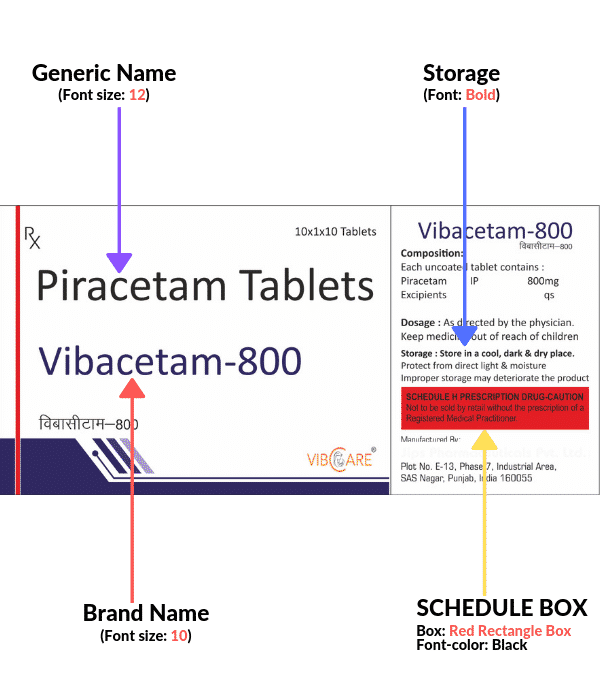
The rule comes from the Drugs and Cosmetics (First Amendment) Rules, 2018, notified as G.S.R. 222(E) on 13 March 2018 and mandatory from 1 April 2019. It requires the generic (proper) name of a drug or fixed-dose combination to be printed in the same font style as the brand name, but in a font size at least two sizes larger, so the active ingredient is the most prominent element on the pack. The brand or trade name must never be written more conspicuously than the generic name, and the generic name cannot be shown in italics or underlined. The one exception: combinations containing three or more active ingredients are exempt from the font-size increase. You can verify the current text on the CDSCO Drugs Rules page.
For example, if the brand name is set at 10 points, the generic name should be at least 12 points:
- Brand name: Vibcacetam (10 pt)
- Generic name: Piracetam (12 pt)
The red box warning rule (Rule 97)
The red-box requirement comes from the Drugs and Cosmetics (Fifth Amendment) Rules, 2018, notified as G.S.R. 408(E) on 26 April 2018 and mandatory from 1 April 2019. It requires the caution or warning applicable to a Schedule G, H, H1 or X drug to be printed in legible black font inside a completely red rectangular box, without disturbing the other conditions on the label. The relevant symbol (Rx, NRx or XRx) must be printed in red in the top-left corner. Official gazette notifications are published on the CDSCO gazette notifications page.
Artwork preparation checklist
a) Products with both a brand name and a generic name
- The generic name must be at least two font sizes larger than the brand name.
- The generic name and brand name should use the same type of font.
- Do not use italics or underline for either name.
- Generic name on the carton / mono-carton: 70% black, or the existing colour used for the generic name.
- Generic name on the foil: 100% black.
- Complete red box for the Schedule H / H1 warning.
- Storage conditions in bold.
- All brand and generic text in upper-lower case.
- No change to existing colour schemes or carton design beyond these requirements.
b) Products with 3 or more ingredients
- Place the brand name in round brackets, in the same colour as the brand name. No change to the font size of the brand or generic name is required.
- Complete red box for the Schedule H / H1 warning.
- Storage conditions in bold. All designs otherwise remain the same.
c) Products with a generic name only
- Complete red box for the Schedule H / H1 warning.
- Storage conditions in bold. All generic text in upper-lower case.
Rules for the warning box
- Do not break the sentence within the schedule warning box.
- Match the font size and font of the warning box to the rest of the artwork text.
- The warning must sit in a completely red rectangular box and must not disturb the other particulars on the label.
Need your label artwork to pass first time? A wrong generic-name size or a missing red box can hold an entire batch at approval. Vibcare's in-house team prepares ready-to-print, Rule 96 and Rule 97-compliant artwork for every partner — font sizing, red warning boxes and Rx / NRx / XRx symbols handled before your pack goes to press.
Why labelling compliance matters
Labelling is not cosmetic — it is a legal requirement under the Drugs and Cosmetics Act, 1940. A mislabelled or misbranded drug can attract civil penalties and, in serious cases, criminal prosecution of the responsible officers, and persistent non-compliance can lead to suspension of the manufacturing or marketing licence. Because the SUGAM portal cross-checks physical packaging against the approved digital artwork during inspections, even a wrong font size or a missing warning box is treated as a violation. For a manufacturer, getting the artwork right the first time protects both the product and the partner whose name is on it.
Latest CDSCO updates (2026)
- Digital artwork via SUGAM: label artwork is now submitted as digital files to the CDSCO SUGAM portal for approval before printing, and inspectors cross-check physical packs against the approved file.
- Pregabalin moved to Schedule H1 (May 2026): Pregabalin formulations now require the Schedule H1 red box, Rx symbol and cautionary text.
- Schedule K syrup exemption removed (June 2026): certain syrups previously exempt now fall under the full labelling requirements.
- Brand-name extensions under review: following a Drugs Consultative Committee recommendation, CDSCO has invited public comments on regulating brand-name extensions, where one brand is used across formulations with different active ingredients.
Because the schedules and exact statutory wording are periodically amended, confirm the current text of Rule 96, Rule 97 and the relevant Schedule before finalising any artwork.
Frequently asked questions
How large should the generic name be compared to the brand name?
Under Rule 96 of the Drugs and Cosmetics Rules, 1945, as amended by the First Amendment Rules, 2018 (G.S.R. 222(E), 13 March 2018), the generic (proper) name of a drug must be printed in the same font style as the brand name but at least two font sizes larger, and must be displayed more prominently than the brand or trade name. It cannot be shown in italics or underlined. The only exception is a fixed-dose combination containing three or more active ingredients, where the font-size increase is not required. The rule has been mandatory across India since 1 April 2019, and exists to promote rational prescribing by making the active ingredient the most visible element on the pack.
What is the red box rule for Schedule H drugs?
Under Rule 97, amended by the Fifth Amendment Rules, 2018 (G.S.R. 408(E), 26 April 2018), a Schedule H drug must display the symbol Rx in red in the top-left corner of the label and carry the warning "Schedule H Prescription Drug — Caution: Not to be sold by retail without the prescription of a Registered Medical Practitioner" in legible black text inside a completely red rectangular box. The red box must not disturb the other mandatory particulars on the label, and the sentence inside it must not be broken across lines. The same red-box format applies to Schedule G, H1 and X drugs, each with its own symbol and warning text.
Which drugs fall under Schedule H1?
Schedule H1 is a defined list of about 46 substances, introduced in 2013 to control antimicrobial resistance and habit-forming drug misuse. It covers third and fourth generation antibiotics — cephalosporins such as Cefixime, Cefpodoxime and Ceftriaxone, carbapenems such as Imipenem and Meropenem, and fluoroquinolones such as Levofloxacin — along with anti-TB drugs such as Isoniazid, Ethambutol and Cycloserine, and habit-forming or psychotropic drugs such as Alprazolam, Diazepam, Codeine and Buprenorphine. Pregabalin was added to Schedule H1 in May 2026. Every Schedule H1 sale must be recorded in a separate register kept for three years.
What symbol goes on a Schedule H1 or Schedule X drug?
Schedule H1 drugs carry the Rx symbol printed in red; if the drug also falls under the Narcotic Drugs and Psychotropic Substances Act, 1985, it carries NRx in red instead. Schedule X drugs carry the XRx symbol in red. In every case the symbol is displayed conspicuously in the top-left corner of the label, and the corresponding warning appears in legible black text inside a completely red rectangular box. Schedule H1 was introduced to control the misuse of specific antibiotics and habit-forming molecules, so its warning also states that the preparation is dangerous to take except in accordance with medical advice.
Since when have these labelling rules been mandatory?
The generic-name font rule (Rule 96) was notified on 13 March 2018 and the red-box warning rule (Rule 97) on 26 April 2018. Manufacturers were given a transition window to exhaust existing packaging material, and both requirements became fully mandatory across India from 1 April 2019. Packaging printed after that date must comply. Because the schedules and the exact statutory wording are periodically amended by CDSCO, manufacturers should confirm the current text of Rule 96, Rule 97 and the relevant Schedule before finalising any artwork.
Do these warnings apply to drugs that are not in any schedule?
Yes. The Fifth Amendment Rules, 2018 extended the red-box warning requirement to a defined list of high-risk categories — narcotic analgesics, hypnotics, sedatives, tranquillisers, corticosteroids, hormones, hypoglycemics, antimicrobials, antiepileptics, antidepressants, anticoagulants and anti-cancer drugs — as well as all drugs falling under Schedules G, H, H1 and X, whether or not they are specifically listed. In practice this means most prescription formulations must carry the appropriate red-box caution or warning, so manufacturers should treat the red box as the default for any drug in these therapeutic categories.
What has changed for drug labelling in 2026?
Three developments matter in 2026. First, drug label artwork is now submitted and approved digitally through the CDSCO SUGAM portal before printing, and physical packaging is cross-checked against the approved file during inspections — even a font-size or missing-warning deviation can trigger penalties. Second, Pregabalin was added to Schedule H1 in May 2026, so its formulations now need the H1 red box, Rx symbol and cautionary text. Third, a Schedule K exemption for certain syrups was removed in June 2026. CDSCO is also consulting industry on regulating brand-name extensions, which may tighten branding rules further.
Related reading
- Retail & wholesale drug licence: required documents (2026)
- Start a PCD pharma franchise with Vibcare
- Exporting medicines from India
- Browse the Vibcare product range
Vibcare Pharma is a WHO-GMP certified manufacturer that prepares fully compliant, ready-to-print artwork for its partners. Looking at starting a pharma franchise or third-party manufacturing with us? We handle Schedule-compliant labelling end to end.

Copy Link



Looking into the future of healthcare



Overview
Company
Contact
Plot No 4, HSIIDC IT PARK, Sector 22,Panchkula, Haryana, India 134109
Phone: 9888988858
Business Hours
Mon-Sat: 9AM to 6PM
Business Enquiry
Request a callback to get more information about becoming a Partner